
Liposomal Vitamin C vs Regular Vitamin C for Lifters
Posted by SDI Labs on Oct 14th 2026
Vitamin C used to be simple: grab a bottle of ascorbic acid and move on. Now you will see "liposomal" vitamin C sold as a premium, better-absorbed form. Is it actually different, and does it matter if you lift?
This post covers what vitamin C does for people who train, what "liposomal" means, what the absorption research really shows, and how much is a sensible amount. Every number comes from the NIH Office of Dietary Supplements or published studies, linked below.
What vitamin C does for people who train
Vitamin C is an essential nutrient, which means your body cannot make it and you have to get it from food or supplements. According to the NIH Office of Dietary Supplements (ODS), vitamin C:
- Is needed to make collagen, the main structural protein in tendons, ligaments, skin, and connective tissue.
- Works as an antioxidant, helping protect cells from free radicals.
- Supports normal immune function.
- Helps your body absorb non-heme iron, the kind found in plant foods.
For lifters, the collagen link is the most interesting one. Hard training puts constant stress on tendons and connective tissue. In a small study by Shaw and colleagues (2017), taking gelatin with vitamin C an hour before a short bout of rope-skipping increased a blood marker of collagen production compared with placebo. That study combined gelatin and vitamin C, so it does not show vitamin C alone does the job, but it shows why vitamin C keeps coming up in conversations about connective tissue.*
How much vitamin C do you need?
The ODS lists the Recommended Dietary Allowance (RDA) for adults as:
- Men: 90 mg a day
- Women: 75 mg a day
- Smokers: add 35 mg a day
The Tolerable Upper Intake Level (UL) for adults is 2,000 mg a day. Above that, the ODS notes the most common problems are diarrhea, nausea, and stomach cramps, because unabsorbed vitamin C pulls water into the gut.
Many people hit the RDA with fruits and vegetables. People who train hard, eat few fruits and vegetables, or smoke often choose a supplement to cover their bases.
Regular vitamin C: well absorbed at low doses, less so at high doses
Regular vitamin C supplements are usually ascorbic acid or a mineral ascorbate. At normal food amounts, your gut absorbs most of it. The ODS fact sheet explains that about 70%–90% of vitamin C is absorbed at moderate intakes of 30–180 mg a day, but absorption falls to less than 50% at doses above 1 gram a day, and the extra is excreted in urine.
That is the main argument for "better absorbed" forms. If you take a gram or more, a lot of plain vitamin C never makes it into your blood.
What is liposomal vitamin C?
A liposome is a tiny bubble made of phospholipids, the same type of fat molecule that forms your cell membranes. In liposomal vitamin C, the vitamin is wrapped in or blended with these phospholipids. The idea is that the phospholipid coating helps protect the vitamin in the gut and lets more of it be absorbed by routes other than the usual vitamin C transporters, which fill up at higher doses.
Not all "liposomal" products are made the same way. Some are liquids, some are powders, and some are capsules. The phospholipid source and the size of the particles vary too.
What the absorption research shows
The research on liposomal vitamin C is newer and smaller than the research on regular vitamin C, but it has grown:
- A 2024 randomized, double-blind crossover trial by Purpura and colleagues gave 27 adults a single 500 mg dose of liposomal vitamin C, regular vitamin C, or placebo. The liposomal form produced about 27% higher peak blood levels and 21% higher total exposure over 24 hours than the same dose of regular vitamin C. It also raised vitamin C in white blood cells more.
- A 2016 study by Davis and colleagues found that a liposomal form raised blood vitamin C more than the same dose of unencapsulated vitamin C, though less than an IV dose.
- A 2025 scoping review of liposomal vitamin C bioavailability found 10 human studies. Nine reported higher bioavailability for the liposomal form. The authors also pointed out that the studies used very different formulas and doses, and only a couple looked at effects beyond blood levels.
The honest takeaway: liposomal vitamin C generally gets more vitamin C into your bloodstream than the same dose of regular vitamin C, based on small studies. Whether that extra absorption leads to better recovery or performance has not been well studied yet. Anyone who tells you otherwise is getting ahead of the research.
One caution: very high antioxidant doses and training
There is one more piece lifters should know. Some research suggests that very high daily doses of antioxidant vitamins may change how your muscles respond to training:
- In a 2014 study on endurance training, Paulsen and colleagues gave people 1,000 mg of vitamin C plus 235 mg of vitamin E daily for 11 weeks. The vitamins blunted some of the cellular changes that usually come from endurance training, though performance gains were similar.
- In a 2014 study on strength training, the same group found that vitamin C and E altered some training-related signaling in muscle, but did not change muscle growth over 10 weeks.
This is not a reason to avoid vitamin C. It is a reason to stick with label doses rather than megadosing, and to make training, food, and sleep the foundation.
Liposomal vs regular vitamin C: which should you choose?
Regular vitamin C may be all you need if:
- You mostly want to cover the RDA.
- You eat plenty of fruits and vegetables.
- You prefer the lowest-cost option.
A liposomal formula makes more sense if:
- You take larger daily amounts, where plain vitamin C absorption drops off.
- You want the form that, in current studies, puts more vitamin C into your blood per milligram.
- Plain high-dose vitamin C upsets your stomach.
How Samson Recover C fits in
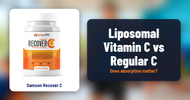
Samson Recover C is our liposomal vitamin C formula built for people who train. Per 2-capsule serving it provides:
- 1,450 mg vitamin C, from ascorbic acid and ascorbyl palmitate (a fat-soluble form of vitamin C).
- 50 mg sunflower phospholipid blend, the phospholipids used in the liposomal-style delivery.
- 200 capsules per bottle, 100 servings.
That serving stays under the 2,000 mg adult UL set by the ODS, as long as you are not stacking other high-dose vitamin C products on top. Samson Recover C supports collagen formation, normal immune function, and antioxidant protection as part of your recovery routine.*
Want to round out your recovery? Pair it with Samson Recover T, our turmeric and curcumin formula, or get both together in the Recovery Bundle. Our weightlifting supplements guide covers where vitamins fit in the bigger picture.
FAQ
Is liposomal vitamin C better than regular vitamin C?
In small human studies, liposomal vitamin C usually raised blood vitamin C more than the same dose of regular vitamin C. Whether that leads to better results has not been well studied yet.
Does liposomal vitamin C absorb better?
Most studies say yes. A 2024 trial found about 27% higher peak blood levels with liposomal vitamin C than regular vitamin C at the same 500 mg dose.
How much vitamin C should I take a day?
The adult RDA is 90 mg for men and 75 mg for women, plus 35 mg for smokers. The ODS sets the adult upper limit at 2,000 mg a day from all sources.
Is 1,000 mg of vitamin C a day too much?
For healthy adults, 1,000 mg a day is below the 2,000 mg upper limit set by the NIH. Very high doses can cause stomach upset or diarrhea.
Should I take vitamin C before or after a workout?
There is no strong evidence for a best time. Take it consistently and follow the label. Taking it with a meal can be easier on your stomach.
Does vitamin C help muscle recovery?
Vitamin C is needed to make collagen and helps protect cells as an antioxidant, which supports your body's normal recovery processes.* Training, protein, and sleep matter most.
Can vitamin C interfere with muscle gains?
One 2014 study found high-dose vitamin C plus vitamin E changed some muscle signaling, but not muscle growth over 10 weeks. Sticking with label doses is a sensible approach.
Can I take vitamin C and turmeric together?
Many people take both. They are separate nutrients with no well-known conflict. Our Recovery Bundle pairs Samson Recover C and Samson Recover T. Ask your doctor if you take medication.
Sources
- NIH Office of Dietary Supplements. Vitamin C: Fact Sheet for Health Professionals.
- Purpura M, et al. Liposomal delivery enhances absorption of vitamin C into plasma and leukocytes: a double-blind, placebo-controlled, randomized trial. Eur J Nutr. 2024.
- Davis JL, et al. Liposomal-encapsulated ascorbic acid: influence on vitamin C bioavailability and capacity to protect against ischemia-reperfusion injury. Nutr Metab Insights. 2016.
- Do liposomal vitamin C formulations have improved bioavailability? A scoping review identifying future research directions. 2025.
- Shaw G, et al. Vitamin C-enriched gelatin supplementation before intermittent activity augments collagen synthesis. Am J Clin Nutr. 2017.
- Paulsen G, et al. Vitamin C and E supplementation hampers cellular adaptation to endurance training in humans. J Physiol. 2014.
- Paulsen G, et al. Vitamin C and E supplementation alters protein signalling after a strength training session, but not muscle growth during 10 weeks of training. J Physiol. 2014.
Shop Samson Recover C
1,450 mg of vitamin C per serving in a liposomal formula with sunflower phospholipids. 100 servings per bottle.
→ Get Samson Recover C on LegalSteroids.com
These statements have not been evaluated by the Food and Drug Administration. This product is not intended to diagnose, treat, cure, or prevent any disease. Talk to your physician before using any dietary supplement, especially if you take medication or have a medical condition. Not intended for anyone under 18.