
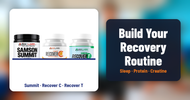
How to Build a Muscle Recovery Routine That Works
Posted by SDI Labs on Oct 19th 2026
Training breaks you down. Recovery is when you build back up. You can have the perfect program, but if you sleep five hours, under-eat protein, and never take a rest day, your progress will stall.
The good news: recovery is not complicated. A handful of habits do most of the work, and they are backed by solid research. This guide ranks them in order of impact, then shows how supplements fit in, with a simple daily schedule at the end.
Step 1: Sleep (the most underrated recovery tool)
If you only fix one thing, fix your sleep.
The American Academy of Sleep Medicine and Sleep Research Society recommend that adults sleep 7 or more hours per night on a regular basis (Watson et al., 2015). Their statement also notes that more than 9 hours may be appropriate for young adults and people catching up on sleep debt.
For athletes, more sleep may mean better performance. In a well-known Stanford study by Mah and colleagues (2011), college basketball players who extended their sleep for 5–7 weeks (aiming for 10 hours in bed) got about 111 more minutes of sleep a night. Their sprint times got faster, their shooting accuracy improved, and they reported less fatigue. It was a small study of 11 players, but it shows how much sleep can matter.
Simple ways to sleep better:
- Keep a consistent schedule, even on weekends.
- Keep your room cool, dark, and quiet.
- Cut caffeine by mid-afternoon. That includes late pre-workouts.
- Put your phone down for the last 30 minutes before bed.
Step 2: Eat enough protein, spread through the day
Muscle is built from protein, and training increases your need for it.
The International Society of Sports Nutrition (ISSN) position stand on protein (Jäger et al., 2017) recommends that most people who exercise eat 1.4–2.0 grams of protein per kilogram of body weight per day. For a 180 lb (82 kg) lifter, that works out to about 115–165 grams a day.
A large 2018 meta-analysis by Morton and colleagues, covering 49 studies, found that protein supplementation increased gains in muscle size and strength during resistance training. Gains in lean mass leveled off at about 1.6 g/kg/day, so going far above that probably will not add more muscle.
How to make it practical, based on the ISSN position stand:
- Aim for about 20–40 grams of protein per meal (roughly 0.25 g/kg per meal).
- Spread it out, about every 3–4 hours.
- Get most of it from food, like meat, fish, eggs, dairy, and legumes. Use shakes to fill gaps.
For more ideas, see our posts on how protein builds bigger and better muscles and three high-protein breakfast recipes.
Step 3: Program rest into your training
Recovery is not only what you do outside the gym. It is also how you plan your training:
- Rest days are part of the plan, not a sign of weakness.
- Rotate muscle groups so the same muscles are not hammered on back-to-back days.
- Use lighter weeks every so often when your lifts stall, your joints feel beat up, or motivation drops.
- Increase training load gradually. Big jumps in volume or new exercises are what tend to cause the worst soreness.
Light movement on off days, like walking, easy cycling, or mobility work, can help you feel less stiff. Our post on stretching has a simple routine.
Step 4: Creatine, the best-studied recovery-friendly supplement
Once sleep, protein, and training are in place, creatine monohydrate is the supplement with the strongest research behind it.
The ISSN position stand on creatine (Kreider et al., 2017) calls creatine monohydrate the most effective nutritional supplement available for increasing high-intensity exercise capacity and lean body mass during training. It also notes research suggesting creatine may support recovery from intense exercise.*
The standard dose is 3–5 grams a day, every day. You can load at about 20 g a day for 5–7 days if you want faster results, but you do not have to. Our full creatine monohydrate guide covers dosing, timing, and common myths.
Samson Summit is pure creatine monohydrate: 5 g per scoop, 60 servings, unflavored, with nothing else in it. Stir it into your shake or morning drink.
Step 5: Recovery support nutrients
With the basics covered, some lifters add targeted nutrients to support recovery. Two of the most popular are vitamin C and curcumin.
Vitamin C
According to the NIH Office of Dietary Supplements, vitamin C is required to make collagen, the main protein in connective tissue, and it is an important antioxidant that supports immune function. Hard training puts constant stress on tendons and connective tissue, which is why vitamin C is a common part of lifters' routines.*
Samson Recover C provides 1,450 mg of vitamin C per 2-capsule serving in a liposomal formula with a sunflower phospholipid blend, which is designed to support absorption.* That is under the 2,000 mg adult upper limit set by the ODS. Our post on liposomal vitamin C vs regular vitamin C explains what the absorption research does and does not show.
One caution: high daily doses of antioxidant vitamins may blunt some training adaptations. In an 11-week randomized, placebo-controlled trial, adults who took 1,000 mg of vitamin C plus 235 mg of vitamin E every day during endurance training improved their VO2 max and running performance about as much as the placebo group, but some cellular markers of training adaptation in muscle (mitochondrial markers) rose only in the placebo group (Paulsen et al., 2014). Stick to the label dose and avoid stacking several high-dose antioxidant products.
Turmeric and curcumin
Curcumin, the main compound in turmeric, has been studied for post-workout soreness. A 2022 meta-analysis of 10 trials found it was associated with less soreness and better muscle function after hard exercise, though not every study agrees.* Curcumin is poorly absorbed on its own, which is why it is often paired with black pepper extract.
Samson Recover T provides 570 mg of turmeric extract (95% curcuminoids) with 10 mg of BioPerine®, plus Boswellia, astaxanthin, and ginger, in one capsule a day with a meal. Our post on turmeric and curcumin for muscle soreness covers the research in more detail.
Want both? The Recovery Bundle pairs Samson Recover C and Samson Recover T in one order.
Step 6: Hydrate
Even mild dehydration can make training feel harder. Drink water through the day, and more when you sweat heavily or train in the heat. A simple check: pale yellow urine usually means you are on track.
A sample daily recovery routine
Here is how it all fits together on a typical training day:
Breakfast
30–40 g protein meal. 1 capsule Samson Recover T with food. 1 scoop Samson Summit in your coffee, juice, or water.
Lunch
30–40 g protein meal. Samson Recover C per the label: 2 capsules a day.
Training
Train hard with good form. Sip water.
Post-workout
Protein shake or meal within a few hours.
Dinner
30–40 g protein meal with vegetables and carbs.
Evening
Screens off 30 minutes before bed. Aim for 7–9 hours of sleep.
On rest days, keep the same protein, sleep, and supplement routine. Creatine in particular works by keeping your muscle stores full, so take it every day.
FAQ
What is the fastest way to recover from a workout?
There is no shortcut. Sleep 7 or more hours, eat enough protein spread across your meals, stay hydrated, and plan rest days. Supplements work best on top of those habits.
How much sleep do I need for muscle recovery?
Sleep experts recommend 7 or more hours a night for adults. In one small study, athletes who slept more ran faster sprints and reported less fatigue.
How much protein do I need to build muscle?
The ISSN recommends 1.4–2.0 g per kilogram of body weight daily for most people who exercise. A 2018 meta-analysis found muscle gains leveled off around 1.6 g/kg.
What are the best supplements for muscle recovery?
Creatine monohydrate has the strongest research. Many lifters also use vitamin C for collagen and immune support, and curcumin for normal post-workout soreness.* Protein powder helps if you cannot hit your target from food.
Does creatine help with recovery?
The ISSN notes research suggesting creatine may support recovery from intense exercise, along with its well-known benefits for strength and lean mass during training.*
How many rest days a week do I need?
It depends on your program, but most lifters do well with one to three rest days a week and with rotating muscle groups so the same muscles are not trained on back-to-back days.
Is it OK to work out while sore?
Mild soreness usually is not a reason to skip training. Light movement can help you feel less stiff. Sharp pain, swelling, or pain that gets worse is a reason to rest and see a professional.
Can I take creatine, vitamin C, and turmeric together?
Yes. There is no known conflict between them, and many lifters stack all three. Talk to your doctor first if you take medication.
Sources
- Watson NF, et al. Recommended amount of sleep for a healthy adult: a joint consensus statement of the American Academy of Sleep Medicine and Sleep Research Society. Sleep. 2015;38(6):843-844.
- Mah CD, et al. The effects of sleep extension on the athletic performance of collegiate basketball players. Sleep. 2011;34(7):943-950.
- Jäger R, et al. International Society of Sports Nutrition position stand: protein and exercise. J Int Soc Sports Nutr. 2017;14:20.
- Morton RW, et al. A systematic review, meta-analysis and meta-regression of the effect of protein supplementation on resistance training-induced gains in muscle mass and strength in healthy adults. Br J Sports Med. 2018;52(6):376-384.
- Kreider RB, et al. International Society of Sports Nutrition position stand: safety and efficacy of creatine supplementation in exercise, sport, and medicine. J Int Soc Sports Nutr. 2017;14:18.
- NIH Office of Dietary Supplements. Vitamin C: Fact Sheet for Health Professionals.
- Paulsen G, et al. Vitamin C and E supplementation hampers cellular adaptation to endurance training in humans: a double-blind, randomised, controlled trial. J Physiol. 2014;592(8):1887-1901.
- Beba M, et al. The effect of curcumin supplementation on delayed-onset muscle soreness ... : a systematic review and dose-response meta-analysis. Phytother Res. 2022;36(7):2767-2778.
Build your recovery stack
- → Samson Summit creatine monohydrate
- → Samson Recover C liposomal vitamin C
- → Samson Recover T turmeric and curcumin
- → Recovery Bundle (Samson Recover C + Samson Recover T)
These statements have not been evaluated by the Food and Drug Administration. This product is not intended to diagnose, treat, cure, or prevent any disease. Talk to your physician before using any dietary supplement, especially if you take medication, are pregnant or nursing, or have a medical condition. Not intended for anyone under 18. BioPerine® is a registered trademark of Sabinsa Corporation.