
Muscle Building Supplements for Men Over 40
Posted by SDI Labs® on Oct 29th 2026
Muscle Building Supplements for Men Over 40: What's Worth Taking
After 40, building muscle still works the same way it did at 25: train hard, eat enough protein, recover, repeat. What changes is how little room there is for wasted effort. Most supplement shelves are built on hype, so this guide puts things in the order that actually matters: training and protein first, then creatine monohydrate, then a multivitamin, then recovery support, testosterone support and heart health.
1. Training comes first: progressive overload
No supplement replaces a training program. The basic principle is progressive overload: over weeks and months, gradually add weight, reps, or sets so your muscles keep getting a reason to adapt.
Volume matters. A 2017 meta-analysis by Schoenfeld and colleagues found a dose-response relationship between weekly resistance training volume and gains in muscle size, with more weekly sets per muscle associated with greater growth (Schoenfeld et al., 2017).
- Train each major muscle group at least twice a week.
- Log your lifts so you know when to add weight or reps.
- Use controlled form and a full range of motion; joints over 40 reward patience.
- Add volume gradually rather than jumping straight to high workloads.
2. Protein: the foundation of your diet
Protein supplies the amino acids your muscles use to repair and grow after training. A 2018 meta-analysis of 49 trials found that protein supplementation during resistance training supported gains in muscle mass and strength in healthy adults, with benefits leveling off around 1.6 g of protein per kilogram of body weight per day (Morton et al., 2018). The same analysis noted that the effect of protein supplementation was smaller in older trainees, which is one more reason to get total daily intake right.
For older adults, the PROT-AGE Study Group recommended a higher daily protein intake than the general adult guideline, at least 1.0 to 1.2 g per kilogram per day for adults over 65, and at least 1.2 g/kg/day for those who exercise regularly (Bauer et al., 2013).
Food first: meat, fish, eggs, dairy, and legumes. A protein powder is simply a convenient way to close the gap when whole food falls short.
3. Creatine monohydrate: the most researched option
Creatine monohydrate is one of the most studied sports supplements available. The International Society of Sports Nutrition's position stand describes it as an effective supplement for increasing high-intensity exercise capacity and lean body mass during training (Kreider et al., 2017).
It is relevant past 40, too. A 2017 meta-analysis of studies in older adults found that creatine taken during resistance training produced greater gains in lean tissue mass and in upper- and lower-body strength than resistance training alone (Chilibeck et al., 2017).
Creatine supports strength and power output during resistance training. It works alongside training, not instead of it.
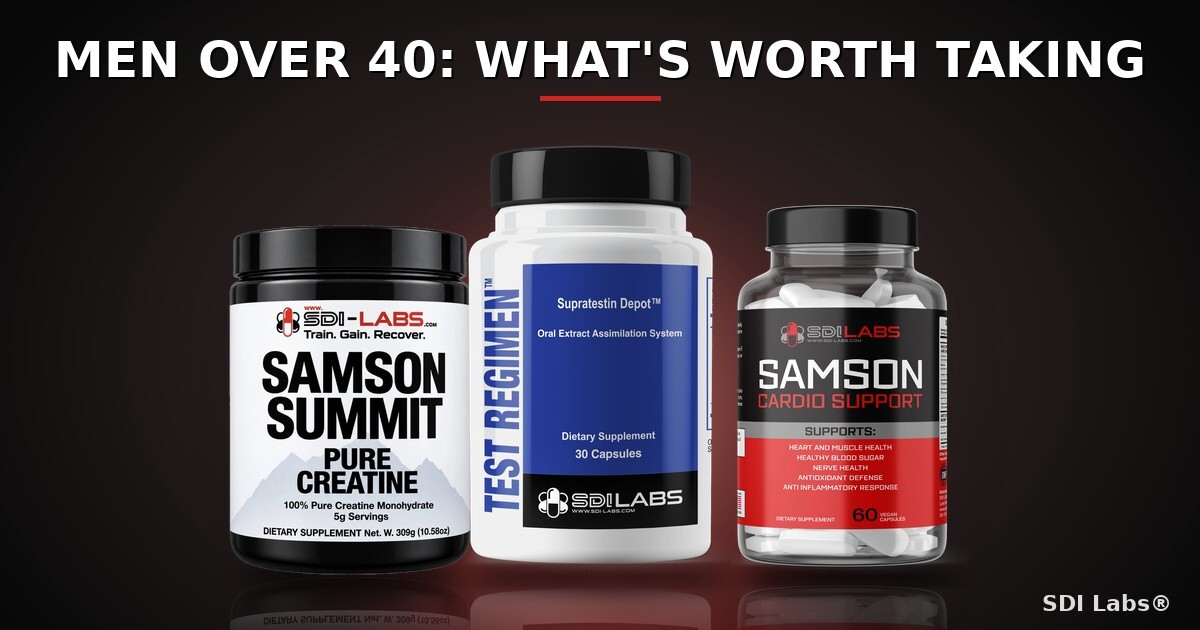
If you want a simple option, Samson Summit™ is unflavored, micronized creatine monohydrate with 5 grams per serving and nothing else added, so it mixes into water or your favorite beverage without changing the taste.
4. A multivitamin: cheap insurance, not a shortcut
A daily multivitamin will not build muscle on its own. What it can do is help cover nutrient gaps when your diet is not perfect. Think of it as support for overall nutrition, not a performance product. If you want one built for training, Samson Vigor is a whole food multivitamin with micronutrients sourced from fruits, vegetables, berries, blue-green algae and spirulina, plus zinc, copper and selenium. It also includes a blend of reishi, cordyceps and turkey tail mushrooms, and each bottle holds 60 capsules.
- Choose a product that provides roughly the daily value of most vitamins and minerals rather than megadoses.
- Look for third-party quality testing on the label.
- Keep eating vegetables, fruit, and whole foods; a pill does not replace them.
5. Recovery support: sleep first
Muscle grows during recovery, not during the workout. The most important recovery tool is free: sleep. Researchers have proposed that sleep plays a key role in muscle recovery after exercise and that sleep loss may work against it (Dattilo et al., 2011).
- Aim for a consistent sleep and wake time.
- Schedule at least one or two rest days each week.
- Stay hydrated and keep protein spread across your meals.
- Use deload weeks when your lifts stall and joints feel beat up.
Recovery-focused supplements can play a supporting role, but they come after sleep, nutrition, and sensible programming.
6. Testosterone support: what the research says
Testosterone levels in men tend to decline gradually with age. The Baltimore Longitudinal Study of Aging, which followed 890 men over time, found that both total and free testosterone fell steadily with age, and that total testosterone was also lower in men with a higher body mass index (Harman et al., 2001).
Several everyday habits matter:
- Sleep. In a small study of healthy young men, one week of sleep restricted to five hours a night lowered daytime testosterone levels (Leproult & Van Cauter, 2011).
- Resistance training. Higher-volume resistance workouts that use large muscle groups produce a short-term rise in testosterone and other hormones after exercise (Kraemer & Ratamess, 2005).
- Body composition. Keeping body fat in a healthy range supports your overall health, and higher body mass index was linked to lower total testosterone in the Baltimore study above.
If you want a supplement in this category, Test Regimen™ contains Supratestin Depot™, a proprietary blend of ingredients formulated to support healthy testosterone levels.* It also includes piperine, which is added to support absorption. Each bottle holds 30 capsules. It is a dietary supplement, and it is not a substitute for medical care. If you think you have low testosterone, see your doctor.
7. Cardio and heart health support
Muscle is only part of the picture after 40. Your heart is a muscle too, and regular aerobic exercise is one of the best things you can do for it. Regular physical activity is widely recognized as beneficial for cardiovascular health, and hearts adapted to exercise show a lower resting heart rate (Nystoriak & Bhatnagar, 2018).
The Physical Activity Guidelines for Americans recommend that adults get 150 to 300 minutes of moderate-intensity aerobic activity each week, or 75 to 150 minutes of vigorous activity, plus muscle-strengthening activities on two or more days a week (Piercy et al., 2018).
- Add two or three cardio sessions a week, such as brisk walking, cycling, or rowing.
- Keep most sessions at a pace where you can still talk.
- Schedule cardio away from heavy leg days, or after lifting, so it does not cut into your strength work.
For nutritional support alongside your training, Samson Cardio Support is formulated to support heart, muscle and nerve health in athletes.* It comes in a 60-capsule bottle. Talk to your doctor before starting a new exercise program or supplement, especially if you have a heart condition or take medication.
The bottom line
For men over 40, what's worth taking is short: a solid training plan built on progressive overload, enough daily protein, creatine monohydrate, a basic multivitamin, real recovery, good sleep for healthy testosterone levels, and regular cardio for your heart. Get those right before spending money on anything else. If you have a medical condition or take medication, talk to your doctor before starting any supplement.
FAQ
What is the best supplement for building muscle after 40?
Creatine monohydrate is one of the most researched options. Studies in older adults show that creatine taken during resistance training supports greater gains in lean mass and strength than training alone.
How much protein do men over 40 need to build muscle?
A meta-analysis of resistance training studies in healthy adults found benefits leveling off around 1.6 g of protein per kilogram of body weight per day. For adults over 65, an expert group recommends at least 1.0 to 1.2 g per kilogram per day, and more for those who are active.
Do I need a multivitamin to build muscle?
No. A multivitamin does not build muscle on its own, but it can help cover nutrient gaps in your diet.
Can supplements replace training?
No. Supplements support a training program built on progressive overload, enough protein, and good sleep. They do not replace it.
What does Test Regimen™ do?
Test Regimen™ contains Supratestin Depot™, a proprietary blend of ingredients formulated to support healthy testosterone levels. It is a dietary supplement, not a substitute for medical care.
What is Samson Cardio Support?
Samson Cardio Support is a dietary supplement formulated to support heart, muscle and nerve health in athletes. It works alongside regular cardio training, not instead of it.
*These statements have not been evaluated by the Food and Drug Administration. This product is not intended to diagnose, treat, cure, or prevent any disease. This article is for general information only and is not medical advice.